
ICV Testimony in Opposition to Senate Bill 277 in House Environmental Affairs Committee
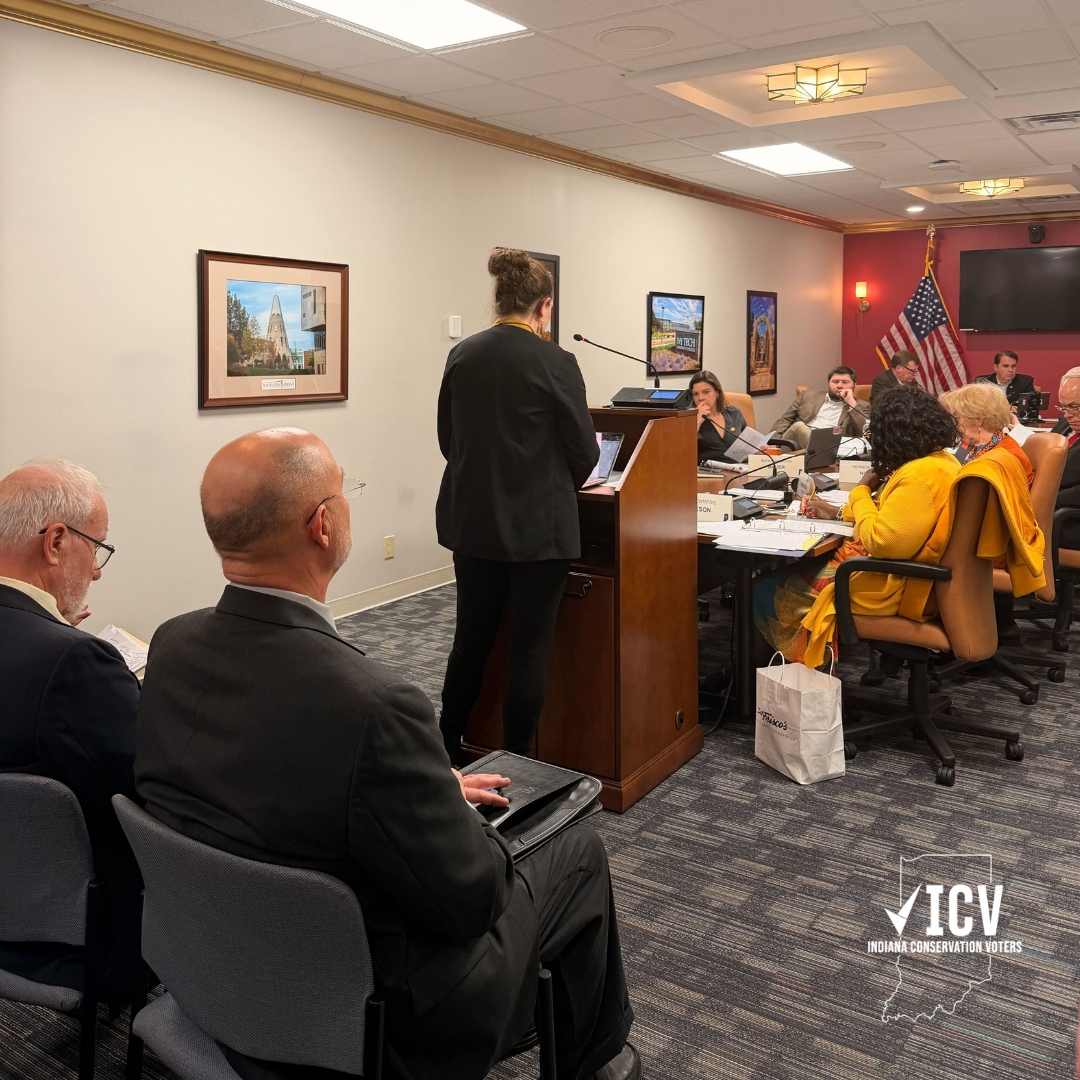
On Feb. 11, 2026, Indiana Conservation Voters Conservation Campaign Manager Desi Rybolt delivered testimony in opposition to Senate Bill 277 in the House Committee on Environmental Affairs. Below is the full text of her testimony as prepared for delivery.
Good afternoon Chairman Baird and members of the committee. My name is Desi Rybolt, and I am the Conservation Campaign Manager with Indiana Conservation Voters. We are here today to express our opposition to Senate Bill 277.
I want to start by expressing our thanks to Chairman Baird, Senator Niemeyer, and Commissioner Woods for their work on this bill and for our conversations with them and with many of you in the past weeks. We appreciate the intent to clean up and update old and outdated code that can be found across the bill. With those sections, we find no fault. However, there are quite a few places that we feel go beyond that and are concerning to us.
One of our primary concerns lies in the changes to the Environmental Rules Board, of which there are several, and how they could interact with each other. We understand some of the underlying thought and intent behind the changes to the ERB, but because we are not only making policy for right now, we feel they may open the door for misuse in future administrations.
Section 67 repeals a requirement for no more than 6 of the 12 appointed members of the board, and section 65 adds a clause that allows the Governor to consider political affiliation when appointing members. Section 65 also repeals a clause that prohibits the two appointed members of the general public from having interests that overlap with other board appointees, meaning there could be an overrepresentation of one or two interests on the board. Section 68 then goes on to add a clause explicitly stating that the Governor can remove a board member at any time, with or without cause. Individually, these changes may have had understandable background. But together, these could have unintended consequences and significantly weight the ERB for political interests rather than maintaining a balanced board.
Between this and the many instances of discretionary changes, we are also concerned that this may result in regulatory uncertainty with each new incoming administration, as each appointee would have equal discretion and thus may approach regulation and enforcement differently. Keeping consistent expectations between administrations also makes sense from a business standpoint.
Many of our partners have or will address other concerns with this bill that we share. This bill is so large and makes so many changes that belaboring each issue is impractical in the time we have today. Again, we do appreciate the efforts during session to meet about this bill, though our ability to dig into this properly has been severely limited by the truncated legislative session.
That said, we are also very concerned about the language included in Amendment 27 regarding PFAS. The subject can get very technical, so I will do my best to keep it brief. The definition of PFAS included in this excludes many of the most toxic PFAS chemicals, including those that are included in the Safe Drinking Water Act Maximum Contaminant Levels. For instance, GenX chemicals do not bioaccumulate, but are highly toxic if ingested. Notably, PFOA and PFOS which are ultimately the two remaining chemicals included have been phased out over recent years and are scarcely used, and we have seen lower blood concentrations after these industry-wide phase-out efforts. The amendment also would focus regulation or research, outreach, testing, and risk communication for PFAS chemicals that are not commonly used today, while we know there are at least four more molecules or mixtures of the thousands of existing PFAS chemicals and counting. These are not just found in manufacturing, but in the blood of about 96% of humans and the game animals we hunt and fish for across the state.
Finally, Section 84 raises the bar for decisions around PFAS that consider health goals/values/thresholds/risk assessments. These are focused on evaluating health risks, and do usually go through peer-review, public comment, etc., however are not formal rules because they don’t have direct regulatory effect—therefore the requirement for federal rulemaking to use these values is unlikely to be met. That they don’t constitute rulemaking is not a reflection of scientific rigor or public process
Ultimately, our recommendation stands from our comments on the Executive Order last summer: discuss changes like these deliberately, openly, and clearly with time enough for proper conversations not cut short by the nature of the legislative session. We would also recommend limiting this bill to the cleanup of outdated references and definitions, and leaving more substantive changes to less rushed timelines.
We hope that, should this bill pass, we have more open conversations and opportunities to properly analyze the proposed changes. For now, we would ask the committee to oppose SB277. Thank you.